


Modern-classic mantel clock on a stone fireplace shelf

Which Mantel Clock Is Best for Your Shelf and Routine?

Choose a mantel clock by its sound, movement and usable case size, then check the exact seller item. Norwalk and Annette offer battery-powered chimes; Debden and Stepney Mechanical require mechanical care. Stepney Quartz is a separate movement option, while Seeley is a conditional time-only reference. Compare the full model code before comparing prices.

Start with the job and the shelf

Publisher: TOPCLOCKS. Source review: October 3, 2026. This is a documentation-based selection, not a hands-on test or a ranking of the whole market. The comparison covers six variants across five designs from three manufacturers. No winner is claimed for sound quality, silence, durability, accuracy, or price. Purchase availability must be checked separately. A seller link does not guarantee stock or the lowest price.

Choose a mantel clock when you want a freestanding time display on a mantel, console or display shelf. Start elsewhere when your main requirement is a wake-up alarm or a clock you can read from a distant wall.

A decorative case does not tell you whether a clock chimes, needs winding, or can stay quiet at night. Decide which of those conditions matters before comparing colors. The six options below cover five designs from three manufacturers, including one design offered with two different movements.

For waking on a schedule, use the Alarm Clocks guide. For the wider choice between clock families, return to TOPCLOCKS.

Illustration of an adult choosing a console-shelf position for a freestanding mantel clock
Illustration of choosing a clock's place in the room; no compared model is pictured.

Which mantel clock is best for your requirements?

Start with the requirement that would rule a clock out. Use these routes to compare documented differences; their order is not a ranking.

  • More chime choices without winding: compare Norwalk B1515 when its case fits and its night window suits the room.
  • A smaller listed tambour case: compare Annette II B1929 with Norwalk, then match the delivered movement and instructions.
  • An eight-day mechanical routine: compare Debden Walnut 22864030340 when mechanical care is a deliberate choice.
  • No scheduled chime: Seeley remains a conditional reference, not an in-stock or silent-clock recommendation.

Someone who likes an audible tick can make a different choice from someone who wants a quiet room. Decide about movement sound and scheduled melody separately. The guide assumes neither a budget nor a preferred sound.

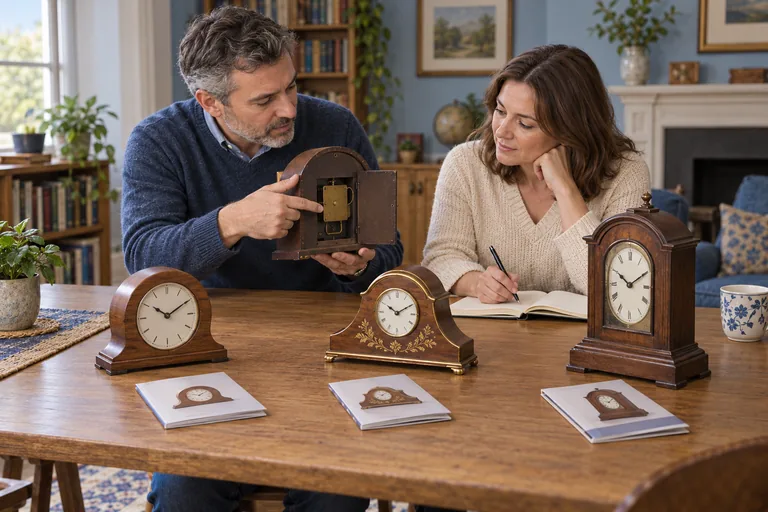
Illustration of an adult choosing between two generic mantel-clock cases beside a booklet
Illustration of choosing a clock for a room; no compared model or product test is pictured.

Compare the models and movement variants

Read case measurements as width × depth × height where the manufacturer labels the axes. These are six documented options, including conditional alternatives—not six tested winners.

Keep the exact movement in view when opening a seller listing. Any seller action in a row applies only to the option named there; it does not confirm stock or the checkout total.

Compare the models and movement variants Show detailsHide details
Mantel-clock choices by documented function and ownership limits
Exact optionPublished case sizeDocumented functionReason to compare itBefore buyingSeller
Norwalk B1515 15.25 × 4.25 × 9 inches Hourly melody choices or quarter-hour Westminster; volume and night controls A battery-powered chime route with several programs Confirm rear access and the matching night schedule. Check the exact seller variant
Annette II B1929 14.25 × 3.75 × 7 inches Hourly Westminster; three AA batteries A smaller listed case than Norwalk Match the actual movement, supplied manual and finish; names and finishes differ between listings. Check the exact seller variant
Debden Walnut 22864030340 Labeled dimensions not established here Mechanical eight-day Westminster; automatic night shut-off A deliberate mechanical upkeep route Confirm labeled size, care instructions and exact night hours. Check the exact seller variant
Seeley 635208 — conditional 16.5 × 2.5 × 9.5 inches One AA; no chime; manufacturer describes a soft tick A time-only comparison reference Manufacturer page showed out of stock on October 3, 2026; other sellers were not verified. Check the exact seller variant
Stepney Mechanical 21092030340 — conditional Labeled dimensions not established here Westminster with automatic night shut-off An alternative mechanical design Winding interval and exact night window require its matching instructions. Check the exact seller variant
Stepney Quartz 21092032114 — conditional Labeled dimensions not established here Westminster and Bim Bam A same-design alternative with a different movement Its battery requirements and night behavior remain unresolved in this source set. Check the exact seller variant

Case depth is not the entire placement check. Keep the base supported and leave access to doors, controls and winding points. No model in this table has been cleared here for a universal distance above an operating fireplace.

Illustration of an adult comparing two different mantel clocks with separate instruction booklets
Illustration of a documentation comparison, not a ranked lineup or a product test.

Use the differences that change the decision

Keep the full model code, movement and finish together. Compare each option’s documented functions and limits, then match the seller’s selected item to its instructions.

Compare for several chime programs

Norwalk B1515: more choices for a scheduled chime

Norwalk documents Westminster, Ave Maria or Bim-Bam on the hour, with a separate quarter-hour Westminster option. Compare it when the choice of sound programs matters. This guide does not establish which melody sounds better.

The linked 67J instructions separate the AA timekeeping cell from two C cells for the chime mechanism. They describe a night option from 11:00 PM to 5:45 AM. That window is not a light sensor, and a melody preview does not prove correct clock/chime synchronization. Keep the existing night-control explanation in view.

Check before ordering: Match the supplied movement instructions and leave room to reach the rear controls.
Compare a smaller listed case with Norwalk

Annette II B1929: compare a smaller case, not a promised quieter movement

The listed width, depth and height are smaller than Norwalk's. Hourly Westminster and three AA cells are documented; this can narrow the choice when the larger case does not fit, without assuming a universal minimum shelf size.

Bulova’s technical page identifies Annette II B1929 with mahogany finish and links two operating documents; its retail page calls B1929 Annette with walnut finish. The model code alone does not resolve that difference. Match the supplied finish and movement before applying a night-control procedure. Norwalk’s melody selection and night hours do not transfer to Annette.

Check before ordering: Match the supplied finish, movement and manual; the shared B1929 code does not resolve the naming and finish differences.

Compare an eight-day mechanical route

Debden Walnut 22864030340: an explicitly documented eight-day movement

Hermle identifies this walnut variant and describes an eight-day mechanical Westminster movement with automatic night shut-off. Compare it when you prefer mechanical ownership and are prepared to follow the appropriate care instructions.

The published dimensions do not label the axes, and the product description does not establish exact night hours. Obtain those details before ordering for a tight space or a specific quiet period. An eight-day specification is not a measured accuracy, service-life, or sound-quality result.

Check before ordering: Confirm Walnut 22864030340, labeled case dimensions, matching care instructions and the exact night hours.

Conditional time-only reference

Seeley 635208: a conditional time-only reference

Seeley has no chime, but its description explicitly includes a soft tick. The manufacturer's page showed it out of stock on October 3, 2026. Keep it as a documented comparison unless the exact item and an acceptable seller are rechecked; do not treat it as the default available purchase.

The dated manufacturer stock notice does not establish discontinuation or availability at every seller. Confirm an acceptable exact-model offer separately.

Check before ordering: No chime does not mean no ticking. Confirm a current exact-model offer separately.

Alternative mechanical design

Stepney Mechanical 21092030340: keep the mechanical movement in the order

The manufacturer lists mechanical Westminster with automatic night shut-off for this Stepney variant. Confirm the Mechanical selection and full SKU on the seller’s page and order summary. The same design is also offered with a quartz movement.

The winding interval, labeled dimensions and exact night hours remain unresolved in this source set. Do not import Debden’s eight-day interval or another clock’s instructions. Use the variant check when a control is essential.

Check before ordering: Keep Mechanical 21092030340 selected. Obtain its own care instructions and night hours.

Alternative same-design quartz variant

Stepney Quartz 21092032114: verify the movement and photograph

The manufacturer lists Westminster and Bim Bam for the Quartz variant. Its battery requirements and night operation remain unresolved here; the mechanical version’s automatic night shut-off is not evidence for Quartz.

A specialist listing names Quartz 21092032114 but also uses Mechanical wording and says its photograph shows the mechanical version. That listing does not resolve the supplied variant. Do not use its photograph to identify Quartz controls or winding points.

Check before ordering: Confirm Quartz 21092032114 through the selected item and order summary; resolve conflicting movement copy and photographs before choosing that seller.

Illustration of two adults comparing generic mantel-clock cases and rear access with instruction booklets
Illustration of comparing cases and documents, not a lineup of the named models or tested winners.

Measure the usable space and access

Measure the shelf and the clock’s complete case, then leave the access its instructions require. Case depth alone does not describe the supporting base, a door’s opening space, or the room needed to reach a rear control.

Use a paper outline to compare width and depth with the usable shelf surface. Account for trim, an uneven edge, nearby objects and the position from which you read the time. Keep the base fully supported on a suitable level surface; do not balance a case on the front lip just because the listed depth looks small.

The Stepney specification does not label its three measurement axes. Get a labeled drawing or confirmation before using that entry to decide whether it fits a narrow shelf. It is better to leave the measurement unresolved than to buy on an assumed dimension order.

A mantel is not automatically a suitable location for a clock when the fireplace is operating. Follow the fireplace and clock manufacturers’ placement instructions; the sources used here do not establish a universal safe clearance or a heat rating for these models. For the separate reading task, see how to check clock size and readability.

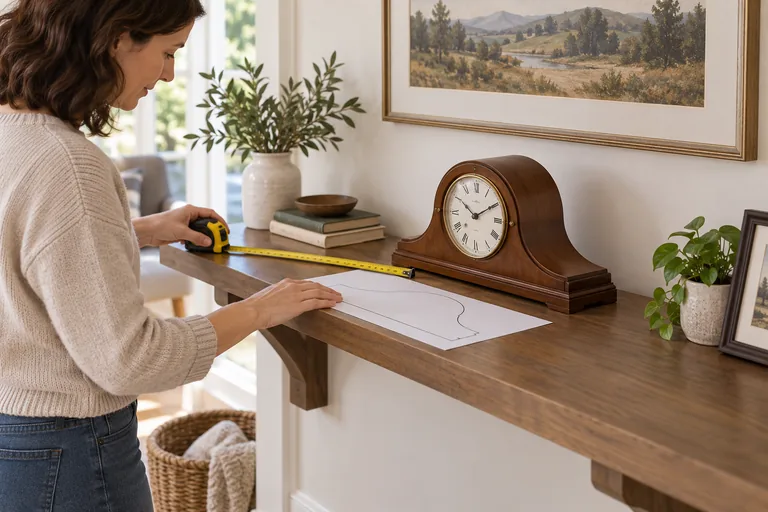
Illustration of a person measuring a console shelf beside a freestanding mantel clock
Illustration of a placement scenario, not a photograph of a compared model or a product test.

Decide what should sound—and when

Choose movement sound and scheduled chimes separately. A no-chime description does not establish silence, and a night setting may silence the melody without establishing what you will hear from the mechanism.

If your priority is an uninterrupted quiet room, ask for an explicit movement description before choosing a decorative chiming model. For the terminology, compare ticking, chimes and quiet claims.

Norwalk’s linked 67J manual specifies a night option from 11:00 PM to 5:45 AM, with an all-hours chime option and a melody-off setting. That is a programmed time window, not a promise that darkness itself turns the sound off. Its internal chime sequence must also be synchronized correctly.

Consider when you would actually hear the clock: calls, television, a bedroom across the hall, or an early-morning routine. A melody you enjoy in a short preview may be unwanted every quarter-hour. Decide whether you want the hourly or quarter-hour option, then verify the selected mode on the received unit.

Illustration of a person reading a clock manual in a shared evening living room
Illustration of a placement scenario, not a photograph of a compared model or a product test.

Keep same-name variants separate

A shared design name is not a shared movement specification. Preserve the movement choice and full SKU when comparing an order, its instructions and a review.

For Stepney, the manufacturer assigns automatic night shut-off to the mechanical version in its feature list. The quartz entry names its two chime choices but does not establish the same night function. This guide therefore leaves that quartz property unresolved rather than marking it present or absent.

Ask the seller for the matching operating document when a control is essential. A photograph of a similar case, another finish’s description or an instruction sheet from a different movement is not sufficient. Keep both the case label and any movement identifier with your purchase records.

Illustration of an owner checking a mantel clock's rear label beside its instructions and shipping carton
Illustration of checking a clock's identity against its own documents; no compared model is pictured.

Plan for batteries or mechanical upkeep

Before paying, obtain the instructions for the maintenance routine you are willing to follow. Battery-powered timekeeping, separate electronic chimes and a mechanical movement require their own procedures.

Norwalk uses one AA for timekeeping and two C batteries for the chime movement in the linked instructions. A running dial does not confirm that the chime power and settings are correct. Follow the manual’s battery-replacement and synchronization sequence rather than guessing from the total cell count.

For a mechanical candidate, confirm the winding interval, supplied key, care requirements and service arrangements for that exact movement. Those details remain unconfirmed for Stepney in this source set. A different clock’s winding procedure or interval does not become applicable just because the brand matches.

Compare the final purchase cost, required consumables, any agreed servicing and seller return terms. No current prices or service charges are asserted here.

Illustration of a person reading a clock booklet beside an unopened battery package and a winding key
Illustration of planning upkeep from instructions; the props do not specify a compared model's procedure.

What should you verify before placing the order?

Confirm the full model code, selected movement and finish before comparing the final checkout total. A product photograph or shared design name does not settle the supplied variant.

  1. Match the comparison’s model code to the seller’s selected item and order summary. Stepney Mechanical and Quartz are separate movement options.
  2. Check the supplied instructions and included items. A photograph does not confirm that a key, batteries or optional accessory is included.
  3. Read the shipping and return terms before paying, including return costs, any restocking charge and conditions for personalization or special orders.

For shelf fit, use the placement checks. For sound, check the chime and night controls. After delivery, follow the existing room check.

Check the received clock once, in the intended room

Use the delivered model’s instructions to confirm operation before settling its final position. The sequence below is a proposed owner check, not an account of testing performed by TOPCLOCKS.

  1. Match the identity. Compare the full model, movement version and supplied instructions with the order. Resolve a different mechanism before applying a procedure.
  2. Check placement and access. Confirm full support for the base, case clearance and access to battery compartments, doors or winding controls. Resolve fireplace placement separately.
  3. Set it by the matching manual. Do not force the hands or apply a universal reset. The 67J document has a specific forward-hand and synchronization procedure; it is not an instruction for every mantel clock.
  4. Observe from the usual seat. Check time readability and movement sound under ordinary daytime and evening conditions.
  5. Verify the chosen sound program. Check the real hour or quarter-hour sequence and the intended night behavior. The 67J monitor plays a preview without setting synchronization; it does not replace this check.
  6. Keep a brief result. Record the exact model, selected mode and any mismatch. Contact the seller with that information while the applicable return option remains available.

Keep documentation and personal observations distinct. TOPCLOCKS’ testing methodology explains that difference. To report a factual error in this guide, use Contact TOPCLOCKS with the model and relevant document.

Illustration of a seated owner viewing a mantel clock from an armchair with a notebook nearby
Illustration of an owner's proposed room check, not testing performed by TOPCLOCKS.

How this selection was made

This selection compares documented differences in case size, sound control, movement and upkeep. Manufacturer pages and the linked Norwalk manual were reviewed on October 3, 2026; the six options cover five designs rather than a complete market survey.

Missing specifications remain unresolved. The Seeley stock notice is a dated manufacturer observation; it establishes no price or physical test result. No weighted score, sales ranking, customer-rating average or commission rate was used to declare a winner.

Before paying, compare the exact item, included parts, total checkout cost and seller terms. There is no current cheapest pick in this guide. Read how TOPCLOCKS separates documentation from observations and use the existing room check to verify the delivered unit.

Illustration of an editor reading clock instructions beside a generic mantel clock, laptop and paper notes
Illustration of document research; it does not represent hands-on testing by TOPCLOCKS.

Mantel clock questions

A few checks can rule out an unsuitable clock before you compare its finish. Use the exact movement’s documentation for the final decision.

Do all mantel clocks chime?

No. Some display the time without a chime, while others play an hourly or quarter-hour sequence. Check movement noise separately; no chime does not mean no tick.

Compare movement sound and chimes

Is a quartz mantel clock necessarily quiet?

No. Quartz describes the timekeeping technology, not a guaranteed sound level. Look for the exact movement description and judge the delivered clock from the place where you will use it.

Check the movement sound

Can two versions of the same mantel clock have different functions?

Yes. A manufacturer can offer the same design with mechanical and quartz movements. Match the full SKU and movement version before transferring a night setting, battery requirement or maintenance instruction.

Check the exact movement variant

Does automatic night shut-off mean the clock reacts to darkness?

Not necessarily. Norwalk’s linked instructions define a time-based night option, so the internal chime sequence must be synchronized. Check the exact clock rather than assuming it has a light sensor.

Read the documented night settings

How much clearance should a mantel clock have?

There is no universal allowance established by this guide. Use labeled case and base measurements, the required access to controls, and applicable placement instructions. A mantel-clock label does not establish permission to place it above an operating fireplace.

Check shelf fit and access

Can I use a chiming mantel clock as a wake-up alarm?

Do not assume an hourly chime is a programmable wake-up alarm. None of the compared documentation is used here to establish that function. Start with an alarm-clock guide when waking at a selected time is the main task.

See the Alarm Clocks guide

Which mantel clock should I compare first?

Start with the requirement that could rule a clock out. Compare Norwalk for several chime programs, Annette II for a smaller listed tambour case, or Debden for a mechanical ownership routine. Then check the exact seller item; a comparison position is not a performance ranking.

Compare by your requirements

Does this selection include a verified silent or cheapest model?

No acoustic winner or current lowest-price model is established here. Seeley has no chime but is described as having a soft tick. A seller link does not establish silence, stock or the final checkout total.

Review the documented choices and limits

Illustration of two people discussing a mantel clock beside an instruction booklet
Illustration of discussing a clock question with the matching instructions at hand.

Sources and limits

These manufacturer pages and the model-linked movement manual support the stated features. They do not establish measured sound, heat tolerance, readable distance or battery life. The dated Seeley stock observation applies to its manufacturer page; availability from other sellers remains unverified.

The comparison covers six variants across five designs from three manufacturers, not the entire mantel-clock market. Unlabeled dimensions, unconfirmed variant features and the Annette instruction/finish differences remain unresolved until matching documentation is available.

The October 7, 2026 commercial review concerns seller identity and offer boundaries. It does not replace the earlier technical-document dates or establish hands-on testing. Product features, seller terms and purchase availability require separate evidence.

Illustration of a mantel clock beside a laptop, an instruction booklet and paper records
Illustration of consulting documents; it does not establish measured performance or unconfirmed features.